Showing posts with label jobs. Show all posts

Monday, May 4, 2015

U.S. Customs and Border Protection (CBPO) - Job Opportunity Announcement – NOW OPEN


U.S. Customs and Border Protection (CBP) is currently hiring 2,000 Customs and Border Protection Officers (CBPO) by September 30, 2015.  A CBPO entry-level job opportunity announcement is currently open on USAJOBS until May 11, 2015 or until 15,000 applications are received.  

CBP Officers play a vital role in preventing terrorists and terrorist weapons from entering the United States and enforcing customs, immigration, and agriculture laws and regulations at U.S. ports of entry.

To ensure the accomplishment of our mission, CBP requires that every employee be reliable, trustworthy, and fit for duty. To meet these standards, applicants must undergo and successfully pass a thorough background investigation (which includes a polygraph examination), a medical examination, two preemployment fitness examinations, a drug test, and a structured interview in order to be placed in a CBP Officer position. Information on how to apply for the CBP Officer career is located on the following CBP webpage:  http://www.cbp.gov/careers/join-cbp/which-cbp-career/cbp-officer.

On this website, you will find the following information:
·            Reporting for Duty and Training

CBP's Office of Human Resources Management (HRM) recruits for the CBPO positions using short-term vacancy announcements throughout the year.  This provides candidates the opportunity to move through the hiring process quickly and efficiently, and facilitates hiring quality candidates to report to the Office of Field Operations Academy fully prepared to join the proud ranks of CBP Officers.  Below is the schedule for the Job Announcements for CBP Officers and Border Patrol Agents that will be open throughout 2015.


                                 CBP Job Announcements for 2015
U.S. Customs and Border Protection Officers
April 27 May 11
U.S. Border Patrol Agents
May 22 – June 8
U.S. Customs and Border Protection Officers
June 26 – July 13
U.S. Border Patrol Agents
October 16 – November 2
U.S. Customs and Border Protection Officers
November 27 – December 14


We need your assistance in reaching our hiring goals.  Please help us fill our ranks with individuals who share our core values of vigilance, integrity, and service to country.  Encourage your friends, neighbors, and family members to visit http://www.cbp.gov/careers to learn more about this occupation that protects our Nation's borders from terrorism, human and drug smuggling, illegal migration, and agricultural pests while simultaneously facilitating the flow of legitimate travel and trade.

By spreading the word about our Agency's upcoming job opportunities, you can help us build a better and stronger CBP.

Follow us on twitter: @CustomsBorder.

Wednesday, July 30, 2014

HNG Meeting August 1, 2014: Agenda: Speaker on "Online Identity Optimization for Job Seekers"

Hello Everyone,

The agenda for this Friday's Hopkinton Networkers Group (HNG) meeting will be a speaker, Greg Page.  The facilitator for this week will be Gil Krispien, filling in for Sheri Ablaza who has a family obligation. We will devote the first hour to the following agenda: Welcome, Landings, Announcements, New Member Intros, and Needs & Leads. Important Note: Please make a serious, concerted effort to arrive before 10:00 AM. We are going to start the meeting on time at 10:00 AM.  In the second hour, Greg will talk about "Online Identity Optimization for Job Seekers."


Important Note:  On August 8th at St. Matthews in Acton, there will be a photo session conducted by William Lam, so if you would like a photo taken of yourself for LinkedIn or elsewhere, then stop by.


Greg gave this talk at St. Matthews on March 28th, and it was so well received, he was asked to give this talk at HNG.  So, for those who missed this presentation or for those who would like to hear it again, then come and visit the Hopkinton Networkers Group.


Online Identity Optimization for Job Seekers

Studies now show that anywhere from 85-95 percent of HR Departments research job candidates' online profiles via sites like Google, Facebook, and LinkedIn.  This presentation covers the basic aspects of online identity optimization, including strategies for accentuating strengths, avoiding common mistakes, and downplaying negative information.  Along with recommendations about how to balance security concerns with the goal of presenting a comprehensive online presence, we mention techniques that people can use to passively monitor their online presence with minimal effort.


Greg Page

Greg has a most interesting background, having come to the topic of social media through his service as an intelligence officer in the conflicts in Iraq and Afghanistan.  He and a military colleague have founded Merrimack Analysis Group to assist both individuals and institutions to manage and optimize their online identities.  Greg has degrees from Stanford and Harvard, and is in the process of earning another at MIT.


Recap of HNG Meeting of July 25, 2014:

Our 126th meeting had 17 people,  this is 1 more than the previous meeting; 3 signed the New Member list. William Lam was our facilitator. There was 1 introduction speech.

We had an Open Forum Discussion and talked about recruiters, social media, and distributed business cards.   There was great interaction among those present.


Schedule for HNG Meetings:

August 1, 2014    Greg Page          "Online Identity Optimization for Job Seekers"
August 15, 2014    Bill Lippincott    To be defined later


General Information

The networking group meets in Hopkinton, at St. John the Evangelist Church parish hall. The meeting occurs, from 10 to 12 noon, and will meet the first and third Friday of the month. The parish hall has a capacity for 250 people and there is plenty of parking spaces in the parking lot and on the street. Around the perimeter of the parish hall are rooms to allow us to have focused network groups or for any other purpose we need. We chose the first and third Friday to allow everyone to attend the Acton Networking Group or any other networking group, if they wanted, on the Friday we do not meet.

We will maintain our close affiliation with Acton Networkers by using the same list-server to share information between the groups. Any e-mails specific to the Hopkinton Networking Group (HNG) will be indicated in the subject line either by "Hopkinton Networking Group" or "HNG"; this way anyone attending these meetings will know the e-mail is intended for them.


We will follow the following agenda items:
* Welcome
* Landings (with doughnuts)
* Announcements
* New member introductions
* Needs and Leads
* Speaker(s), Workshop, or Focus Group
* Cleanup


For those new members who give their introductions, this is what we would like to know:
* Name
* Skills and Value Statement
* Where have you been?
* Where are you going?
* Your title
* Your target companies
* Geography of search
* Name and e-mail address

If anyone wants to join our team, please let one of us know; we could always use the extra help and input for ideas.

Directions:
Take Rt. 495 North/South and get off Exit 21A. Go through three traffic lights. Colella's Supermarket is on the right at the third traffic light. The first street after the third traffic light is Church Street, take a right turn. The church is on the right. Go around to the left of the parking lot and go into the side entrance of the parish hall.


Depending upon where you live, perhaps you may want to use Mapquest for a more direct route. The address of the church is:
St. John the Evangelist
20 Church Street
Hopkinton, MA 01748


Regards,
Hopkinton Networkers Group (HNG) Coordinators:
Sheri Ablaza            sheriablaza@gmail.com
Grace Carcich          gracec814@gmail.com
Emilia Gordon          emiliagne@gmail.com   
Gil Krispien              g.krispien@verizon.net   
William Lam             wmlam508@yahoo.com       
Laura Startzenbach  laura.startzenbach@gmail.com       

Sunday, October 20, 2013

Boston Job Fair - Thursday, November 7, 2013

Where
Sheraton Boston Hotel
39 Dalton Street
Boston, MA 02119

When
Thursday, November 7, 2013
11:00 AM to 2:00 PM

Who
Wegmans Food Market, Sheraton Hotels, Rite Aid, Eliot Community Home Services & Comcast Cable are just a few of the companies that will be meeting with attendees at the Boston Job Fair on Thursday, November 7th. For more information and to register for the job fair, go to www.premiumjobfairs.com

What
1) FREE ADMISSION!
2) Bring at least 20 copies of your resume
3) Dress professionally and be ready to interview
4) Come with a positive winning attitude – It will make a difference!
5) Arrive at the Job Fair no later than 11 AM


For more information, visit: www.premiumjobfairs.com

Wednesday, April 24, 2013

Job Search Jam Sessions ready to return June 14


The economic outlook still has no prediction on a return to ‘full employment’. Recent Dept of Labor statistics show more than 3 applicants for each posted job and hundreds more dropping off the unemployment count.

This Job Search Jam Sessions event will provide you with help for your job search and explore alternatives like entrepreneurship. Sessions will provide you with the tips and tricks to build your network and explore the use of social media tools.

While many runners train for a long time to start the Boston Marathon in Hopkinton, the Job Search Jam Sessions is an event to help you prepare to deal with your job search. “This is an ‘unconference’ for the unemployed and underemployed,” says Steve Sherlock, lead organizer. “The event’s organizers and session facilitators all have experience dealing with the challenges of layoffs and unemployment, and they are enthusiastic about sharing what they’ve learned to help your job search.”

In coordination with the Hopkinton Networking Group, Job Search Jam Session 4 will offer networking opportunities and motivational support for unemployed and under-unemployed workers.  New and recent college graduates are welcome to participate to learn and share the tips and tricks of the job search.

Job Search Jam Session 4 is scheduled for Friday, June 14, from 9:00 a.m. to 4:00 p.m. The location: St. John the Evangelist Parish Center, 20 Church Street, Hopkinton, Mass. The event has the capacity to serve up to two hundred job seekers from Massachusetts, Rhode Island and anyone willing to get to Hopkinton.

Persons interested in attending should register at http://jobsearchjamsessions.blogspot.com

The cost is – $8 per person.  You can pay via credit card or cash at the door. 

Attendees will be asked to check in at the Parish Center on Jun 14, between 8:30 and 9:00 a.m.  Coffee, refreshments and snacks will be available for the morning and afternoon break. Lunch will also be served during the conference.  

Proceeds from ticket sales will help defray expenses. Any ‘profit’ will be donated to the Church in return for the use of their facility.

Directions to the St. John the Evangelist Parish Center can be found on the church’s website (http://www.stjohnhopkinton.com).

“Job Search Jam Session participants will be able to acquire dozens of new LinkedIn connections. More importantly, they will share experiences from the job search with their peers, learn what has worked for others, and at the end of the day they’ll return home more informed, more confident and motivated to pursue new opportunities.”

Job Search Jam Sessions Agenda

The event will feature both seminar-like sessions and informal opportunities to network in small groups. Speakers are still being lined up. The agenda will be adapted to reflect the needs and interests of participants. There will be sessions devoted to job interviews, your elevator pitch, and the use of social media sites such as LinkedIn, Facebook and Twitter.

Information on specific sessions will be posted to http://jobsearchjamsessions.blogspot.com as the schedule is filled in.

Friday, March 8, 2013

16,100 New Jobs Estimated for January 2013, Unemployment holds steady at 6.7%


Commonwealth of Massachusetts Executive Office of Labor and Workforce Development

FOR IMMEDIATE RELEASE                                                        March 7, 2013

Contact:–Kevin Franck, 617.626.7121(o), 617.823.7580 (c)
Follow us on Twitter

REVISED NUMBERS SHOW MASSACHUSETTS CREATED 32,100 MORE JOBS IN 2011 AND 2012 THAN PREVIOUSLY ESTIMATED

16,100 New Jobs Estimated for January 2013, Unemployment holds steady at 6.7%


BOSTON MA - March 7, 2013 – Revised benchmark numbers from the U.S. Bureau of Labor Statistics released today show that Massachusetts created 92,800 jobs in 2011 and 2012, 32,100 more jobs than previously estimated. Revisions to the statewide unemployment rate also show very little month-to-month change for 2012.

Every year, the Bureau of Labor Statistics (BLS) releases year-end revisions to its previous estimates for job growth and unemployment. While initial estimates of job growth are based on surveys of representative samples, the benchmark revisions are based on actual data collected from employers in the Commonwealth through September 2012. Revised jobs numbers for the last quarter of 2012 are still based on projections.

"We still have work to do to make sure everyone in Massachusetts who wants a job can find one and that companies who want to hire can find the employees they need but these new jobs number based on actual data make me more confident than ever that our investments in innovation, infrastructure and education are helping the Commonwealth recover faster and stronger," said Labor and Workforce Development Secretary Joanne F. Goldstein. "These jobs estimates show a steady job recovery and more continuous job growth compared to previously published estimates for 2011 and 2012."

The revised unemployment numbers, drawn from newly revised data, show that the unemployment rate for every month of 2012 was between 6.6% and 6.8% and there was very little change from month-to-month.

In January 2013, the Massachusetts unemployment rate was 6.7%. According to the BLS, 19,300 private sector jobs were created while government jobs declined by 3,200. Thus, the Commonwealth added 16,100 jobs in the first month of 2013.

2011-2012 Benchmark Job Growth Revisions by Sector
Education and Health Services: Previous estimates showed jobs in Education and Health Services increased by 300 in 2011 followed by a gain of 7,300 jobs in 2012. Revised estimates show Education and Health Services gained 13,800 jobs in 2011followed by a gain of 13,900 jobs in 2012. 

Construction: Previous estimates showed jobs in Construction decreased by 2,000 in 2011 followed by a gain of 300 jobs in 2012.  Revised estimates show Construction added 5,400 jobs in 2011 followed by a gain of 2,400 jobs in 2012.

Leisure and Hospitality: Previous estimates show jobs in Leisure and Hospitality decreased by 2,200 in 2011 followed by a gain of 6,300 jobs in 2012.  Revised estimates show Leisure and Hospitality gained 7,200 jobs in 2011 followed by a gain of 10,700 jobs in 2012. 

Manufacturing: Previous estimates showed jobs in manufacturing increased by 2,300 in 2011 followed by a decrease of 1,100 jobs in 2012. Revised estimates show Manufacturing lost 1,100 jobs in 2011 followed by a loss of 2,500 jobs in 2012.

Government: Previous estimates showed Government jobs declined by 6,000 in2011 followed by a gain of 900 jobs in 2012. Revised estimates show government lost 3,600 jobsin 2011followed by a gain of 6,200 jobs in 2012.

Professional, Scientific and Business Services: Previous estimates indicated this sector added 9,900 jobs in 2011 and another 22,800 jobs gained in 2012. Revised estimates show 16,200 jobs added in 2011 and another 9,300 jobs gained in 2012.

January 2013 Employment Overview

Professional, Scientific, and Business Services added 5,100 (+1%) jobs over the month. Over the year, Professional, Scientific, and Business Services added 15,100 (+3.1%) jobs with gains across all components.

Trade, Transportation, and Utilities added 2,400 (+0.4%)jobs over the month with gains across all components. Over the year, Trade, Transportation, and Utilities added 6,500 (+1.2%) jobs; Retail Trade added 3,600 (+1%) jobs; Transportation added 2,600 (+3.1%) jobs; and Wholesale Trade added 300 (+0.2%) jobs.

Leisure and Hospitality added 3,300 (+1%) jobs over the month due to gains in both components. Over the year, Leisure and Hospitality added 10,700 (+3.3%) jobs.

Construction added 2,400 (+2.1%) jobs over the month. Over the year, Construction added3,700 (+3.2%) jobs.

Other Services added 1,300 (+1.1%) jobs over the month. Over the year, Other Services added 2,700 (+2.2%) jobs.

Information added 700 (0.8%) jobs over the month. Over the year, Information gained 2,300 (+2.7%) jobs.

Financial Activities added 100 (+0.0%) jobs over the month. Over the year, Financial Activities gained 500 (+0.2%) jobs; Finance and Insurance lost 300 (-0.2%) jobs; Real Estate, Rental and Leasing added 800 (+2%) jobs.

Education and Health Services gained 1,900 (+0.3%) jobs over the month. Over the year, Education and Health Services gained 14,300 (+2.1%) jobs.

Manufacturing gained 2,100 jobs (+0.8%) over the month. Over the year, Manufacturing lost 1,500 (-0.6%) jobs.

Mining and Logging gained no (0.0%) jobs. Over the year, Mining and Logging lost 200 (-18.2%) jobs.

Government lost 3,200 (-0.7%) jobs over the month. Local Government lost 1,400 (-0.5%) jobs, State Government lost 1,600 jobs (-1.3%) and Federal Government lost 200 (-0.4%) jobs. Over the year, Government gained 3,000 (+0.7%) jobs.

Labor Force Overview
The January 2013 estimates show 3,251,000 Massachusetts residents were employed and 232,900 were unemployed, for a total labor force of 3,483,900. The January labor force increased by 2,100 from 3,481,800 in December, as 2,800 more residents were employed and 600 fewer residents were unemployed over the month. The labor force was 7,400 above last year's level, with 9,400 more residents employed and 2,000 fewer residents unemployed.  

The unemployment rate is based on a monthly sample of households. The job estimates are derived from a monthly sample survey of employers.As a result, the two statistics may exhibit different monthly trends.

NOTES:
Beginning with the March 2011 estimates, the Bureau of Labor Statistics (BLS) has assumed responsibility for the production of the CESState and sub-state jobs estimates. BLS has also implemented methodological changes which may increase the month to month variability of the estimates. See Changes to procedures for producing Current Employment Statistics (CES) State estimates.
Local area unemployment statistics for January 2013 will be released on Tuesday, March 12, 2013. The preliminary February 2013 and revised January 2013 unemployment rate, labor force data and jobs estimates for Massachusetts will be released on Thursday, March 21, 2013.  See Media Advisory for a complete list of release dates.
Detailed labor market information is available atwww.mass.gov/lmi.
###


Monday, November 12, 2012

Battered Career Syndrome – two great resources


LinkedIn

Suzanne Gray has sent you a message.
Date: 11/09/2012
Subject: Battered Career Syndrome – two great resources
Hi -

I hope all is well on your end and that fall has been treating you well. I am running into quite a few folks who have had their career de-railed, postponed or taken out of their control. Yet, we are brought up believing that having a job is something that we do as a responsible adult. So, when one job isn't working out, we jump to another…only to get the same results.

People typically take one of two paths to approaching this career dilemma:

Focus in on a job that fits
A good resource for this is the Advanced Career Transition on-line program.
This is a series of 12 workshops designed to help people be more creative in
their job search. Check out the list of topics here:
www.advancedcareertransition.com

Explore business ownership
We are hosting a virtual expo Nov 15-17, which is a free on-line event for people
considering business ownership. Click here:
www.startabusinessweekend.com/?sgray for more details.

Feel free to share these resources or give me a call.

Take care,

Suzanne (603)-585 3110

Don't want to receive e-mail notifications? 


Thursday, October 4, 2012

HNG 10/5/12 Agenda; Speaker on "Law of Attraction: Five Basic Principles for Positive, Creative, and Successful Aging"


Hello Everyone,
The agenda for this Friday's Hopkinton Networkers Group (HNG) meeting will be featured by our speaker, Joellyn Schwerdlin. This is Joellyn's sixth presentation at HNG, and they have always been well received.  The facilitator for this week will be Gil Krispien. We will devote the first hour, from 10 to 11 AM to the following agenda: Welcome, Landings, Announcements, New Member Intros, and Needs & Leads. Please arrive early, so we can make every effort to start on time. In the second hour, Joellyn will talk about "Law of Attraction: Five Basic Principles to Make Your Career Dreams Come True."


Law of Attraction: Five Basic Principles to Make Your Career Dreams Come True

1) Five Basic Principles of Law of Attraction

* Understand sympathetic vibrations: like attracts like
* Raise your vibrations: the importance of feeling good
* Change your mood: you have the power
* Follow four steps to deliberate creation
* Allow the Law of Attraction to work: The absence of doubt

2) How to apply Law of Attraction principles to attract your ideal job and career
She will also be raffling off a book -- Law of Attraction: The Science of Attracting More of What You Want and Less of What You Don't written by Michael J. Losier.

About Joellyn Schwerdlin


Joellyn Wittenstein Schwerdlin is a Certified Career Management Coach in private practice (based in Worcester, Massachusetts) serving executives, managers and professionals in career transition. Since 1991, Joellyn has helped countless clients across multiple industry sectors find perfect career paths which are fun, fulfilling and financially-rewarding. Visit her website to learn more www.career-success-coach.com


Recap of HNG Meeting of September 21, 2012:

Our 84th meeting of HNG had 41 people, this is five more than the previous meeting, and 13 signed the New Member list. Salpi Sarafian was our facilitator. There were ten introduction speeches.

We had a speaker, Dorian Mintzer, who talked about "Here Come the Boomers: New Possibilities for Positive, Creative, and Successful Aging." In her interactive presentation, she talked about the following topics:
* Some of the "myths" of aging
* Normal "shifts" in identity and roles that occur as we get older
* Some 21st century strategies for thinking about work
* Is "positive aging" an oxymoron?
* Some important conversations for transitioning to the "second half of life"
* The importance of connection, engagement, and purpose and meaning of life.
* The importance of thinking about our "legacy."


Schedule for HNG Meetings:
October 19, 2012       TBD
November 2, 2012     Jen Vondenbrink "LinkedIn"
November 16, 2012   Cheryl Landes "Working with Contract Agencies"
December 7, 2012     TBD
December 21, 2012  TBD


General Information:

The networking group meets in Hopkinton, at St. John the Evangelist Church parish hall. The meeting occurs, from 10 to 12 noon, and will meet the first and third Friday of the month. The parish hall has a capacity for 250 people and there is plenty of parking spaces in the parking lot and on the street. Around the perimeter of the parish hall are rooms to allow us to have focused network groups or for any other purpose we need. We chose the first and third Friday to allow everyone to attend the Acton Networking Group or any other networking group, if they wanted, on the Friday we do not meet.

We will maintain our close affiliation with Acton Networkers by using the same list-server to share information between the groups. Any e-mails specific to the Hopkinton Networking Group (HNG) will be indicated in the subject line either by "Hopkinton Networking Group" or "HNG"; this way anyone attending these meetings will know the e-mail is intended for them.


We will follow the following agenda items:
* Welcome
* Landings (with doughnuts)
* Announcements
* New member introductions
* Needs and Leads
* Speaker(s), Workshop, or Focus Group
* Cleanup


For those new members who give their introductions, this is what we would like to know:
* Name
* Skills and Value Statement
* Where have you been?
* Where are you going?
* Your title
* Your target companies
* Geography of search
* Name and e-mail address


If anyone wants to join our team, please let one of us know; we could always use the extra help and input for ideas.


Directions:
Take Rt. 495 North/South and get off Exit 21A. Go through three traffic lights. Colella's Supermarket is on the right at the third traffic light. The first street after the third traffic light is Church Street, take a right turn. The church is on the right. Go around to the left of the parking lot and go into the side entrance of the parish hall.


Depending upon where you live, perhaps you may want to use Mapquest for a more direct route. The address of the church is:
St. John the Evangelist
20 Church Street
Hopkinton, MA 01748


Regards,
Hopkinton Networkers Group (HNG) Coordinators:

Tuesday, July 17, 2012

Job Search Strategy Session - July 20

The Hopkinton Networking Group and Workforce Central Career Center in Milford are putting together a "Job Search Strategy Session" from the employers point of view.


Friday, July 20 beginning at 10:00 AM - come early to network


Where: 20 Church St, Hopkinton, MA 01748


Monday, June 25, 2012

Still an uphill battle for job seekers

Sent to you by Steve Sherlock via Google Reader:

via Economic Policy Institute - Feed by Heidi Shierholz on 6/19/12

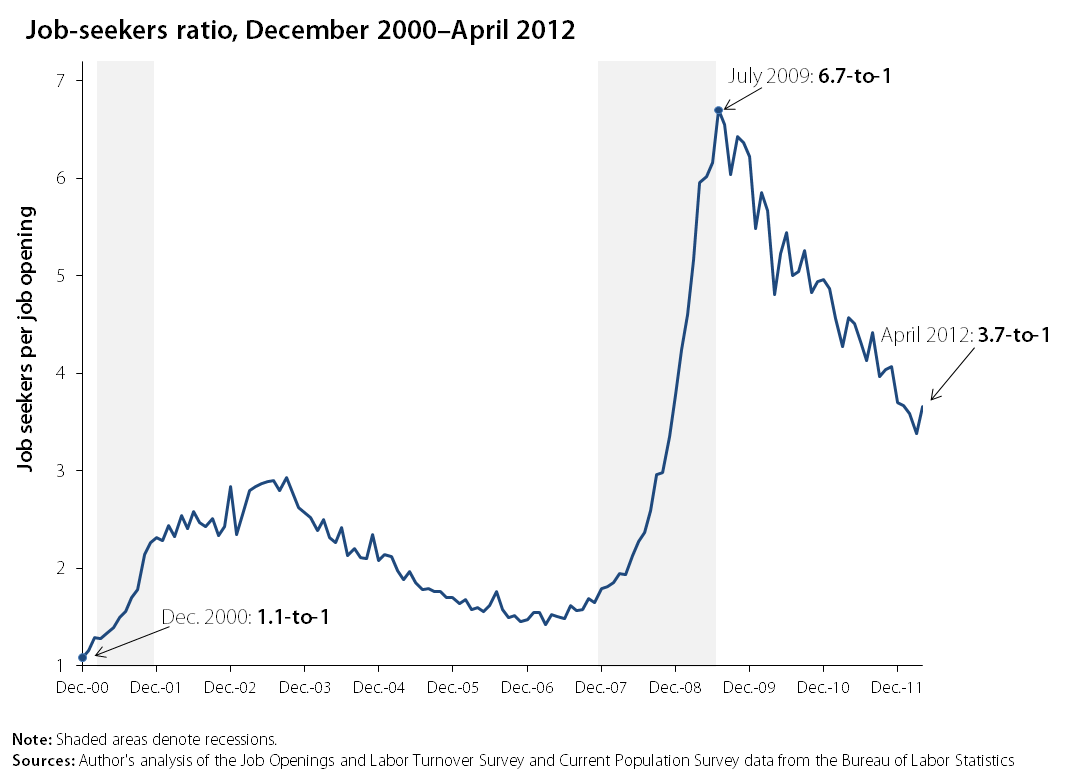
The April Job Openings and Labor Turnover Survey (JOLTS), released today by the Bureau of Labor Statistics, underscores the sluggishness of the recovery, showing that job openings declined by 325,000 in April. Given April's drop in unemployment of 173,000 (unemployment data are from the Current Population Survey and can be found here), this means that the "job-seekers ratio"—the ratio of unemployed workers to job openings—increased by three tenths, to 3.7-to-1.

MORE: Sort through updated graphs using data from today's report
Despite this increase, the ratio has been slowly but steadily improving since its peak of 6.7-to-1 in summer 2009, and it is likely that April's increase represents month-to-month variability in the data rather than a reversal of that overall trend. However, the odds are still stacked strongly against job seekers; a job-seekers ratio above 3-to-1 means that for more than two out of three unemployed workers, there simply are no jobs.


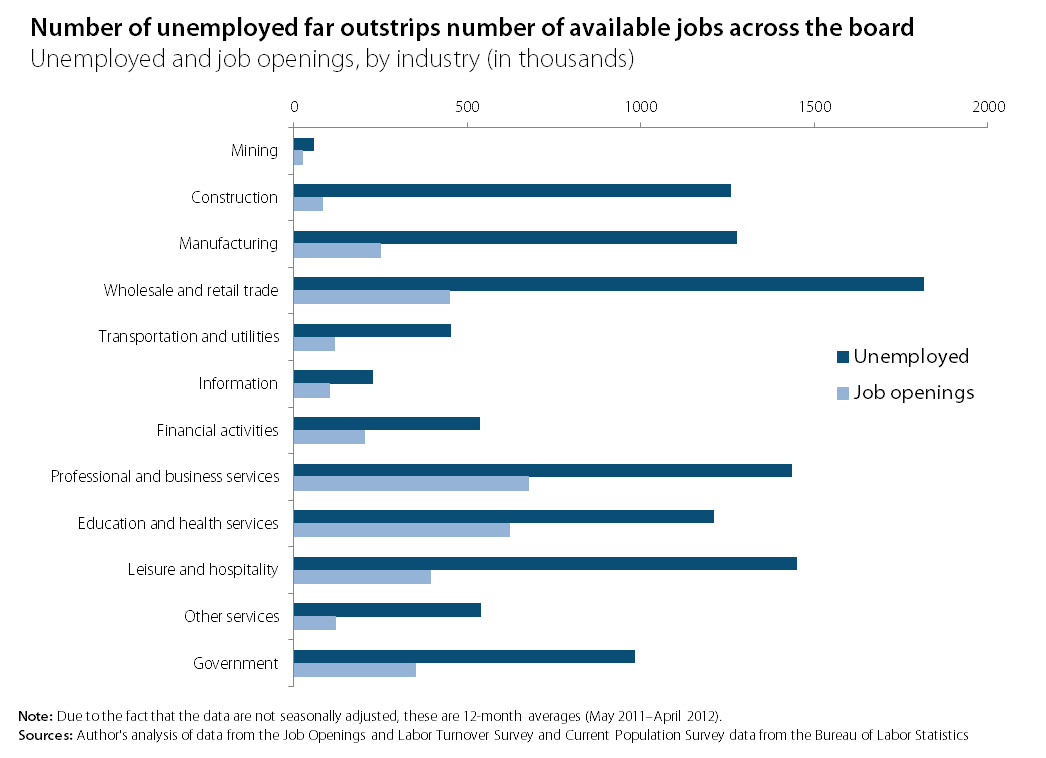
The JOLTS data are particularly useful for diagnosing the cause of today's persistent high unemployment. The figure below shows the number of unemployed and the number of job openings by sector. Unemployed workers far outnumber job openings in every sector. This underscores that by far the main cause of today's persistent high unemployment is a broad-based lack of demand for workers—and not, as is often claimed, available workers lacking the skills needed for the sectors with job openings.


Unsurprisingly, given the drop in job openings, hires also declined in April, by 160,000. Looking at the data over time, however, hires nevertheless are on a slow upward climb, up 13.5 percent since the official start of the recovery in June 2009. But hiring still has a long way to go before it returns to healthy levels. For example, hiring is still 19.6 percent below its 2007 average.
Voluntary quits decreased by 89,000 in April (lower levels of voluntary quits are not good news, since they signal that workers are less confident about outside job opportunities). However, voluntary quits are also on a general upward climb, having increased 18.3 percent since June 2009. But they too have a long way to go; voluntary quits are still 28.2 percent below their 2007 average.

Layoffs also increased slightly in April, by 68,000. Despite April's increase, the number of layoffs remains at a "normal" level; in fact, it is still below the 2007 average. While the consequences of being laid off are much more severe now due to limited job availability, the likelihood of being laid off is no greater now than before the Great Recession started.
With research assistance from Nicholas Finio and Hilary Wething

Things you can do from here:

Thursday, May 31, 2012

‘Missing workers’ mean the unemployment rate is understating weakness in the...

Sent to you by Steve Sherlock via Google Reader:

via Economic Policy Institute - Feed by Heidi Shierholz on 5/30/12

The labor force participation rate (the share of working-age people who either have a job or are jobless but actively seeking work) has dropped by more than two percentage points since the start of the Great Recession in Dec. 2007. According to a recent EPI analysis, roughly two-thirds of this decline is due to weak job prospects in the recession and its aftermath (these changes are generally labeled cyclical), while the remaining one-third is a result of long-term trends such as baby boomers beginning to retire (changes generally labeled structural). The cyclical portion of the decline in the labor force participation rate represents nearly four million workers who would be in the labor market if job prospects were strong. The existence of this large pool of "missing workers"—workers who have either dropped out of or never entered the labor market because of the lack of job opportunities—means that the unemployment rate is understating weakness in the labor market.

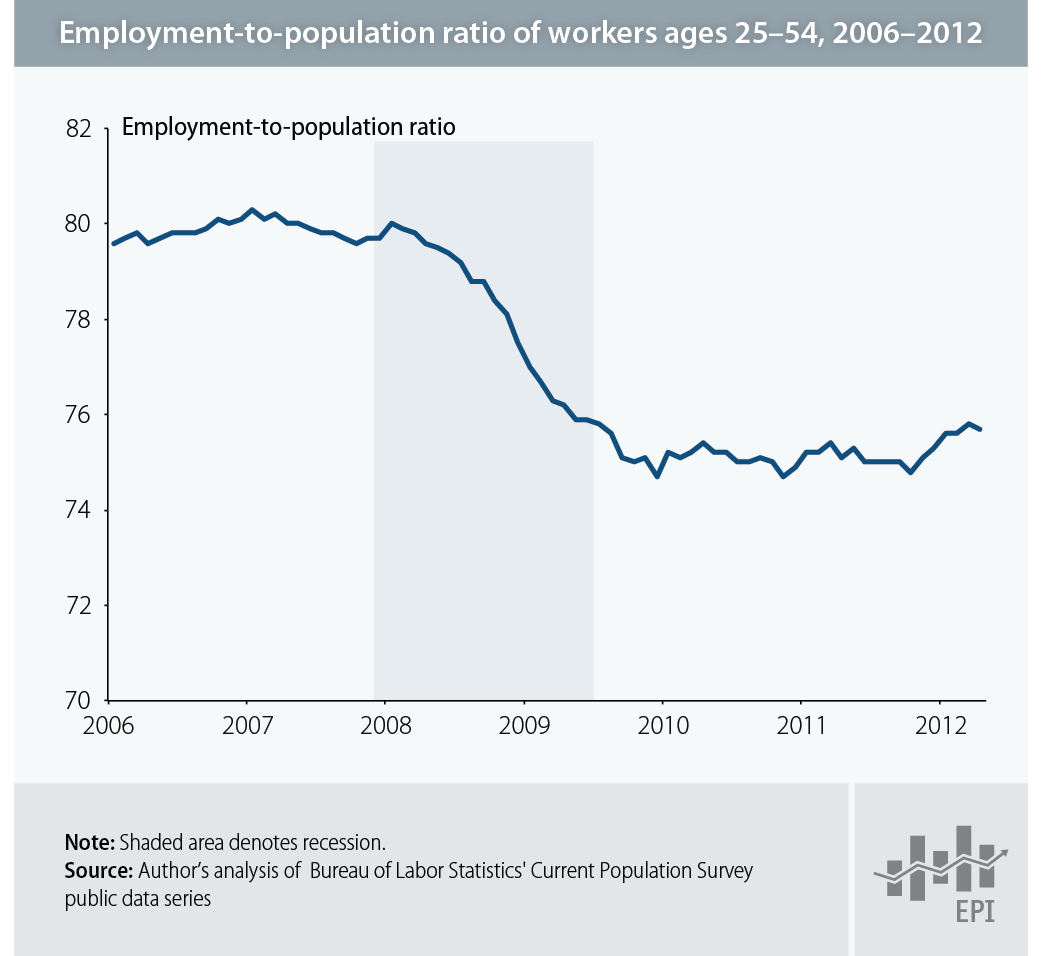
Arguably the best single measure for assessing recent labor market trends is the employment-to-population ratio of 25-54-year-olds, which is simply the share of the 25-54 population that has a job. The restricted age range—25-54-year-olds, or people of "prime working age"—helps insure that trends are not being driven by retiring baby-boomers or increasing college enrollment of young people, but are instead caused purely by changes in job opportunities.

As the figure shows, the share of employed workers 25-54 plunged dramatically from the start of the Great Recession through the fourth quarter of 2009, and then, for nearly two years, essentially bumped around at the bottom of that extremely deep hole. Since the fall of last year, the ratio has just begun to show signs of improvement.


This means that the improvement in the unemployment rate, from 10.0 percent in Oct. 2009 to 8.1 percent in April 2012, has largely been due to people dropping out of, or not entering, the labor force—not to a larger share of potential workers finding work. This also means that while expansionary policies to generate demand are urgently needed and will help spur job growth, they may also generate upward pressure on the unemployment rate as these missing workers begin to enter or reenter the labor market. That kind of upward pressure on the unemployment rate would be a positive sign.


Things you can do from here:

Wednesday, May 9, 2012

Soft skills still outweigh education in entry-level hires: infographic

Sent to you by Steve Sherlock via Google Reader:

via Posts from the Econsultancy blog by Heather Taylor on 5/8/12

The marketing world is known for its love of hiring interns but with unemployment rates on the rise, are internships really going to lead to new jobs for graduates? And what are employers looking for?
A new study by Millennial Branding and Experience reveal an employment gap between employers and students. Even though 91% of employers think students should have between one and two internships before graduation, 50% haven't hired any interns in the last six months. In fact, over three quarters of employers have hired 30% fewer interns into full time positions of late.
As for social media, currently only 16% of employers look to social media to recruit and 35% use those networks for background checks. The majority of them looking to LinkedIn and Facebook in the hiring process. Thankfully, for those twitter addicts out there, only 2% check Twitter…for now.
What exactly are these employers looking for in entry-level talent? Jennifer Floren, Founder and CEO, Experience found the results rely less on education.
Of all the things employers look for when hiring entry-level talent, it's the so-called 'soft skills' that are valued most: communication, teamwork, flexibility and positive attitude are by far the most sought-after skills. Employers understand that everything else can be taught, so they look for the most promising raw material to work with.
This study is interesting for those looking at how we are hiring in this digital age. Keeping these results in mind, employers need to look at evolving their hiring processes and graduates may need to be more targeted at how they approach the opportunities they take before joining the workforce.

Things you can do from here:

The odds of finding a job are improving, but are still stacked against job s...

Sent to you by Steve Sherlock via Google Reader:

via Economic Policy Institute - Feed by Heidi Shierholz on 5/8/12

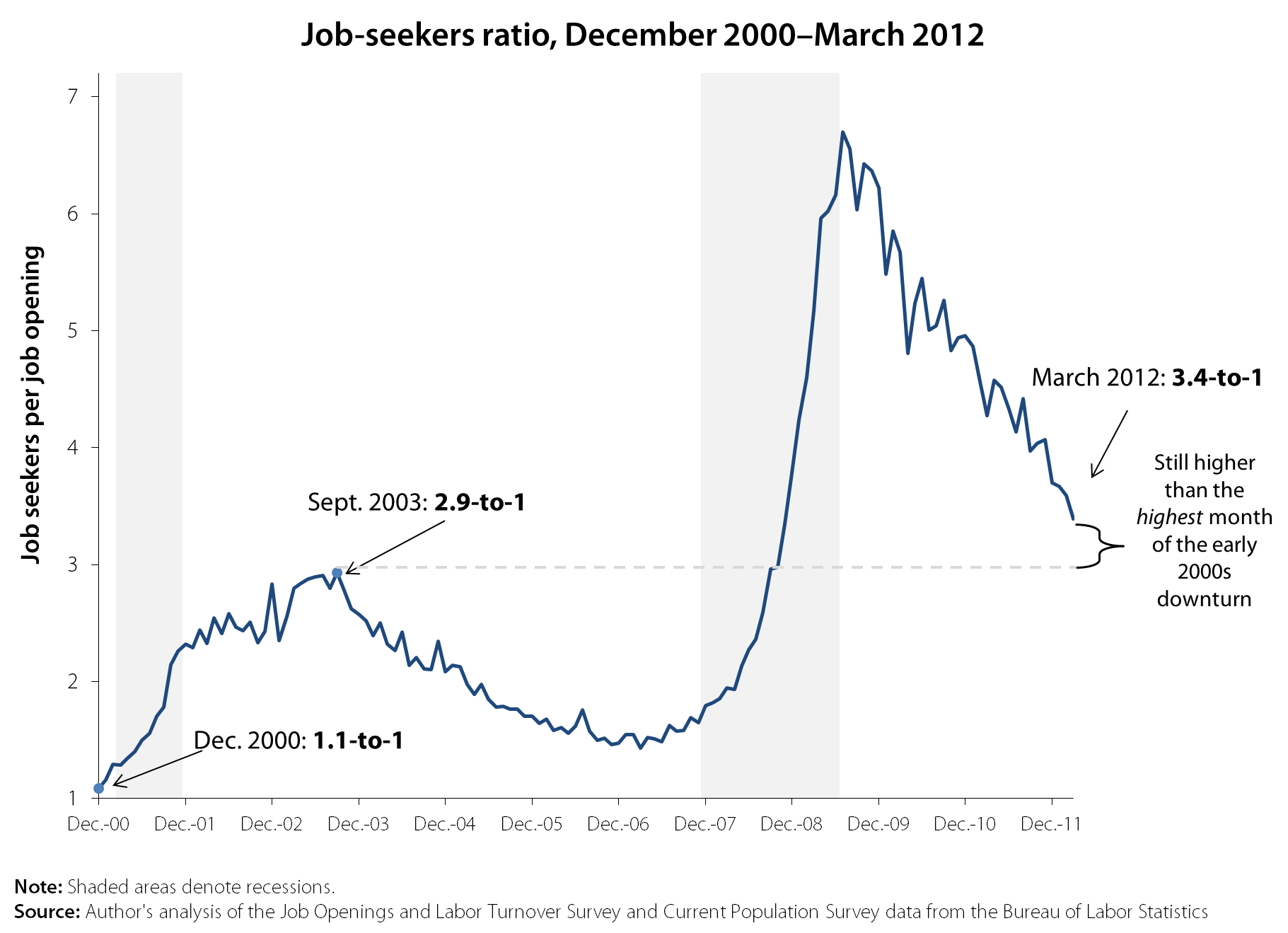
Today's release of the March Job Openings and Labor Turnover Survey (JOLTS) from the Bureau of Labor Statistics was mixed. Job openings increased by 172,000 in March. In combination with the drop in unemployment of 133,000 in March, this means that the "job seekers ratio"—the ratio of unemployed workers to job openings—declined moderately to 3.4-to-1. However, as the figure shows, it is still well above the highest point it reached during the early 2000s downturn, which was 2.9-to-1. Though there has been steady improvement in the last two-and-a-half years in the odds of finding a job, the odds are still stacked against job seekers. Furthermore, there is no major sector in which the odds for job seekers are strong. The number of unemployed workers outnumbers job openings across the board, underscoring that the main issue in the labor market is a broad-based lack of demand for workers, not workers being in the wrong sectors or having the wrong skills.
MORE: Sort through updated graphs using data from today's report

The increased job openings did not translate into increased hires in March, as hires dropped slightly by 88,000 as compared with the previous month. Looking at the data over time, however, hires nevertheless are on a slow upward climb, up 18.4 percent since the official start of the recovery in June 2009. But hiring still has a long way to go before it is back to healthy levels. For example, hiring is still 16.1 percent below its 2007 average.
Voluntary quits increased slightly by 75,000 in March (higher levels of voluntary quits are good news, since they are a signal that workers feel more confident about outside job opportunities).  Voluntary quits are also on a general upward climb, having increased 22.7 percent since June 2009. However, they too have a long way to go; voluntary quits are still 25.6 percent below their 2007 average. For a discussion of how the low level of voluntary quits signifies a lack of advancement opportunities for young workers in particular, see pages 12–14 of "The Class of 2012:  Labor market for young graduates remains grim."
With research assistance from Natalie Sabadish and Hilary Wething

Things you can do from here:

Wednesday, February 8, 2012

Job growth at the best companies to work for

Sent to you by Steve Sherlock via Google Reader:

via FlowingData by Nathan Yau on 1/24/12

Job Growth
Nicolas Rapp and Anne Vandermey with a straightforward look at new jobs added at the top 100 companies to work for, according to Fortune.
Fat paychecks, sweet perks, fun colleagues, and over 70,000 jobs ready to be filled — these employers offer dream workplaces. Like Google, which reclaims the top spot this year to become a three-time champion. Meet this year's top 100, network with the winners on LinkedIn, and more.
Number of new jobs added or lost is on the horizontal, and number of employees at the start of the year on the vertical. Bubble size represents number of job applicants.
There were 7.6 million applicants to Starbucks last year. That's insane.
[Nicolas Rapp]

Things you can do from here:

Thursday, December 15, 2011

Job-seekers ratio remains above 4-to-1 for 34th straight month


Sent to you by Steve Sherlock via Google Reader:


via Economic Policy Institute - Feed by Heidi Shierholz on 12/13/11

Today's Job Openings and Labor Turnover Survey (JOLTS) release from the Bureau of Labor Statistics shows that the number of job openings decreased by 110,000 in October to 3.3 million. The total number of unemployed workers in October was 13.9 million (unemployment is from the Current Population Survey). Therefore the ratio of unemployed workers to job openings was 4.3-to-1 in October, a deterioration from the revised September ratio of 4.1-to-1.

To put this figure in context, it's useful to note that the highest this ratio ever got in the early 2000s downturn was 2.8-to-1, and in December 2000, the month the JOLTS survey began, the ratio was 1.1-to-1. While the job-seekers ratio has been generally slowly improving since its peak of 6.9-to-1 in the summer of 2009, today's data release marks two years and 10 months—147 weeks—that the ratio has been above 4-to-1. A job-seekers ratio of more than 4-to-1 means that for more than three out of four unemployed workers, there simply are no jobs. In October, there were 10.6 million more unemployed workers than job openings. Furthermore, the lack of job openings relative to unemployed workers is in no way limited to particular industries such as construction—unemployed workers dramatically outnumber job openings across the board, in every major industry.

The fact that we have had a job-seekers ratio above 4-to-1 for 147 weeks underscores the crucial need for extended unemployment insurance benefits, which last a maximum of 99 weeks. There are 5.7 million people in this country who have been unemployed for more than half a year, up from 1.2 million in 2007. Of course, the reason for this is not that these millions of workers have become lazy, unskilled, or unproductive; it is that there are not enough jobs available. This is no time to cut the number of weeks of benefits, as the House of Representatives appears ready to do. With the Congressional Budget Office projecting an unemployment rate of 8.5 percent at the end of next year, continuing federally funded unemployment insurance benefit extensions through 2012 would extend a lifeline to the families of millions of long-term unemployed workers, and generate spending that would support well over half a million jobs.

—with research assistance from Nicholas Finio


Things you can do from here: