Sent to you by Steve Sherlock via Google Reader:
via Economic Policy Institute - Feed by Heidi Shierholz on 5/8/12
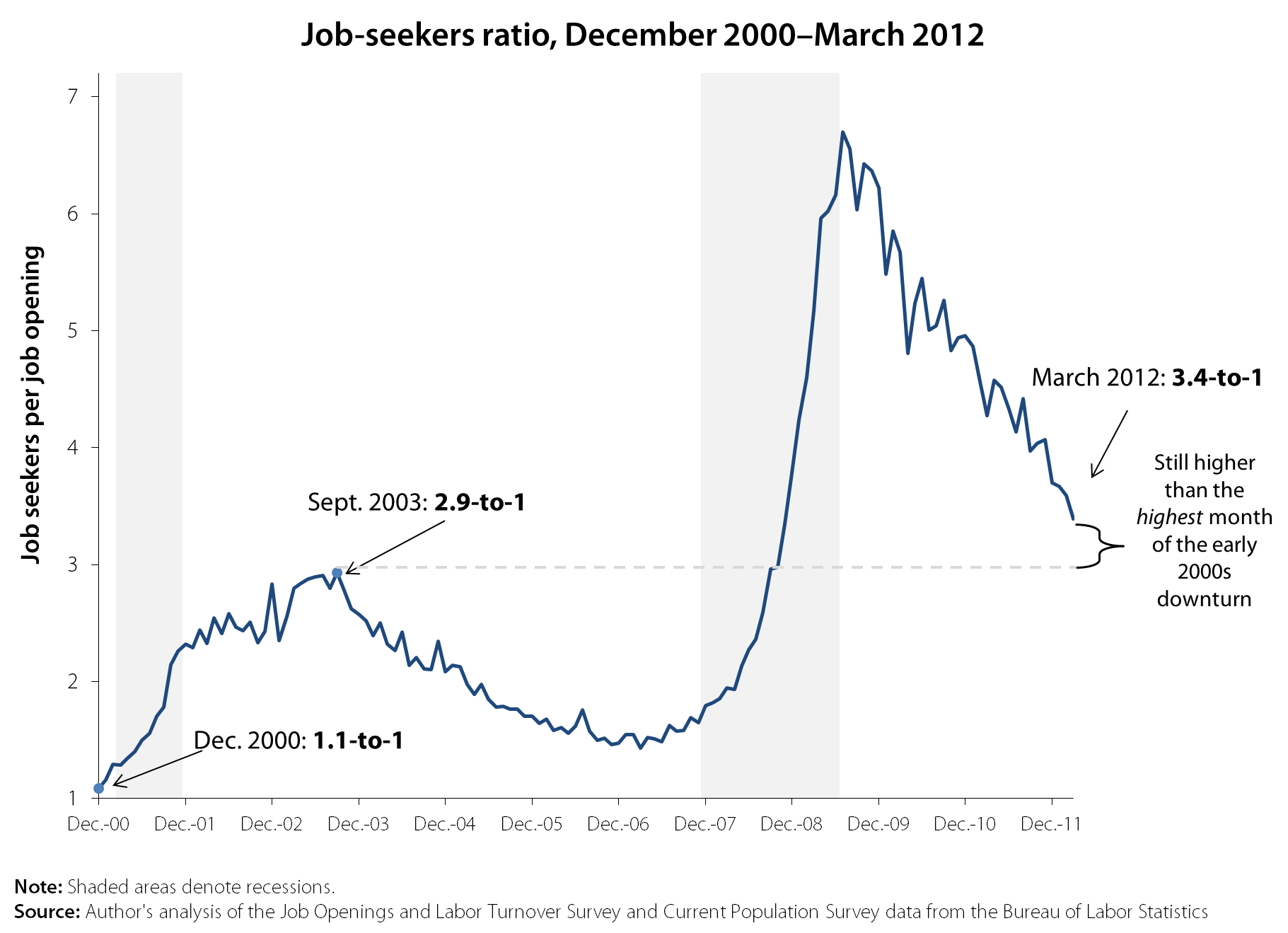
Today's release of the March Job Openings and Labor Turnover Survey (JOLTS) from the Bureau of Labor Statistics was mixed. Job openings increased by 172,000 in March. In combination with the drop in unemployment of 133,000 in March, this means that the "job seekers ratio"—the ratio of unemployed workers to job openings—declined moderately to 3.4-to-1. However, as the figure shows, it is still well above the highest point it reached during the early 2000s downturn, which was 2.9-to-1. Though there has been steady improvement in the last two-and-a-half years in the odds of finding a job, the odds are still stacked against job seekers. Furthermore, there is no major sector in which the odds for job seekers are strong. The number of unemployed workers outnumbers job openings across the board, underscoring that the main issue in the labor market is a broad-based lack of demand for workers, not workers being in the wrong sectors or having the wrong skills.
MORE: Sort through updated graphs using data from today's report
The increased job openings did not translate into increased hires in March, as hires dropped slightly by 88,000 as compared with the previous month. Looking at the data over time, however, hires nevertheless are on a slow upward climb, up 18.4 percent since the official start of the recovery in June 2009. But hiring still has a long way to go before it is back to healthy levels. For example, hiring is still 16.1 percent below its 2007 average.
Voluntary quits increased slightly by 75,000 in March (higher levels of voluntary quits are good news, since they are a signal that workers feel more confident about outside job opportunities). Voluntary quits are also on a general upward climb, having increased 22.7 percent since June 2009. However, they too have a long way to go; voluntary quits are still 25.6 percent below their 2007 average. For a discussion of how the low level of voluntary quits signifies a lack of advancement opportunities for young workers in particular, see pages 12–14 of "The Class of 2012: Labor market for young graduates remains grim."
With research assistance from Natalie Sabadish and Hilary Wething


Things you can do from here:
- Subscribe to Economic Policy Institute - Feed using Google Reader
- Get started using Google Reader to easily keep up with all your favorite sites

